
In this article
In my last article, I made the case that a nonprofit needs a website of its own: one reliable home for its mission, contact details, donation links, volunteer information, and official social media accounts.
There is a piece of that conversation that surprises people more often than it should: the website needs an address. That address is called a domain name.
If an organization is named Example Animal Rescue, its domain might be exampleanimalrescue.org. People type that name into a browser, click it from a social media profile, or see it on a flyer. It is how they find the organization online. Just like your phone number is how people call you, your domain name is how people “call” your website.
It is also an asset the organization needs to understand and protect.
A domain name is not the website
This is the simplest way I know to explain it:
- A domain name is the address:
exampleanimalrescue.org. - A website is the information and pages people see when they visit that address.
- Web hosting is the service that stores and serves the website.
- Email is a separate service that can use the same domain, such as
[email protected].
They work together, but they are not the same thing.
You can own a domain name without having a website. You can change web hosts without changing the address people use. You can use the same domain for a website, organization email, and other services over time.
That flexibility is why the domain matters. It is the stable name people learn and trust, even when the technology behind it changes.
Registering a domain means holding the rights to use it
You do not buy a domain forever in the same way you buy a chair or a truck. You register it for a period of time, often one year at a time and then keep renewing it.
The organization that registers the name is called the registrant. The company that handles the registration is the registrar. ICANN’s registration guide explains the distinction, but the practical point is straightforward:
The nonprofit should be the registrant and should control the registrar account.
Do not leave the organization’s primary domain solely inside a volunteer’s personal account, a former board member’s email address, or a web designer’s private login. Those people may be trustworthy. They may also move, get busy, lose access, or simply forget where the account is. A domain should outlast every individual involved with the organization.
Use an organization-controlled email address for the registrar account when possible. Keep more than one authorized person able to recover the account. Turn on automatic renewal and two-factor authentication. Record the registrar, renewal date, account-recovery process, and who has access in the organization’s internal records.
That is not bureaucracy for its own sake. Losing control of your domain can take down your website and organization email at the same time. There are much better ways to add excitement to a nonprofit’s week.
Why .org makes sense for a nonprofit
For many nonprofits, .org is the natural primary address. People recognize it as a common home for mission-driven organizations, charities, clubs, foundations, and community groups.
One important clarification: .org is not proof that an organization is a registered charity or a 501(c)(3). It is an open domain extension. According to Public Interest Registry, which operates .org, anyone can register and use a .org domain name.
That does not make .org a bad choice. It simply means the organization still needs to earn trust through clear information, consistent contact details, honest statements about its status, and transparent operations. I will cover that side of the equation in a future article.
Why own the matching .com address too?
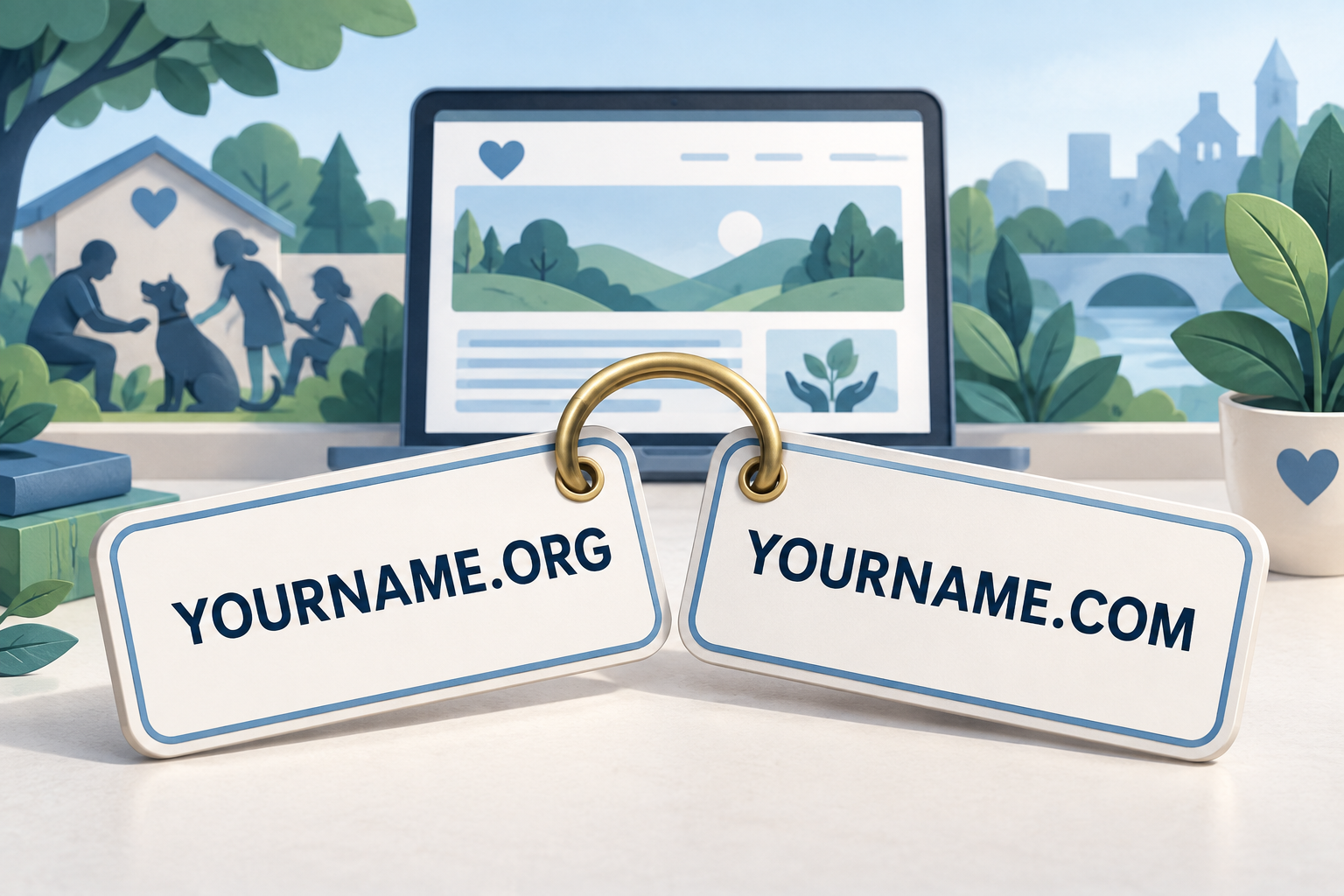
If your nonprofit uses exampleanimalrescue.org as its public address, someone will eventually type exampleanimalrescue.com out of habit. It may be a potential donor, a volunteer, a reporter, or a person trying to verify that they found the real organization.
If the nonprofit owns both names, that moment is easy. The .com can simply redirect to the official .org website.
That provides a few practical benefits:
- It catches people who naturally try
.comfirst. - It prevents a different person from registering the most obvious matching address later.
- It reduces confusion when the organization is mentioned aloud, printed on a flyer, or shared without a clickable link.
- It gives the organization flexibility if its public strategy changes in the future.
The goal is not to collect every possible domain extension. That becomes expensive quickly and offers diminishing returns. Start with the exact organization name under .org and .com, plus a small number of obvious variations only if there is a real reason to expect confusion.
It reduces risk. It does not make impersonation impossible.
Owning the matching .org and .com is sensible defensive housekeeping. It stops one very easy form of confusion.
It does not stop someone from registering a lookalike such as a misspelling, adding an extra word, or using another extension. It does not prevent a fake social media profile, a misleading email, or a dishonest fundraiser.
That is why this is only one part of protecting a nonprofit’s public identity. The organization should also use a consistent name and logo, publish its official website and social links in clear places, protect its email and domain accounts, and pay attention when supporters report something suspicious.
A short domain checklist for nonprofits
Before moving on to the next project, make sure the organization can answer these questions:
- Do we own the exact domain name people are most likely to search for?
- Do we own both the matching
.organd.com, or have a documented reason not to? - Is the nonprofit, rather than an individual, listed as the registrant?
- Can at least two trusted, authorized people access or recover the registrar account?
- Are automatic renewal and two-factor authentication enabled?
- Does the unused matching domain redirect to the official website?
- Do our printed materials, social profiles, email signatures, and donation pages all point to the same official address?
If the answer to any of those is no, the fix is usually much easier today than it will be after an expired domain, a confused supporter, or an impersonator forces the issue.
Own the front door
A nonprofit website gives an organization a home on the web. Its domain name is the address on the front door.
Choose it carefully. Put it under the organization’s control. Keep it renewed. And where it makes sense, own both the .org and .com versions so people who are trying to find you do not accidentally find someone else.
It is a small, practical investment in clarity and trust, two things every nonprofit needs before it asks anyone to support its work.
If you need help with your registering your domain name or have any questions, please feel free to reach out to me.